Dividend Kings Are Not Just Better Dividend Aristocrats. They're a Completely Different Animal.
No S&P 500 requirement. No minimum market cap. That means a tiny regional bank or a niche candy company can sit on the same "elite" list as Coca-Cola. Here's what the labels actually filter for — and what slips through the cracks.
7/10/20269 min read


Think of it this way: Aristocrats are like the honor roll students who've proven themselves for a solid quarter-century. Kings are the tenured professors who've survived everything from disco to TikTok without missing a payment. Both are impressive, but one has literally twice the track record. The Kings list is smaller (around 54 companies versus 68 Aristocrats), but that's because surviving 50 years of economic chaos is brutally hard.
So which should you pick? The answer depends on whether you want broader diversification and growth potential (Aristocrats) or maximum dividend safety from battle-tested survivors (Kings). Most smart investors don't choose one over the other. They build portfolios that include both, grabbing the stability of proven Kings and the growth potential of younger Aristocrats that haven't hit the half-century mark yet.
Key Takeaways
Dividend Aristocrats require 25+ years of increases and S&P 500 membership, while Dividend Kings need 50+ years with no index requirement
Kings offer slightly higher average yields and better downside protection due to their longer track records through multiple crises
The best strategy combines both categories to balance maximum dividend safety with growth potential and sector diversification
Core Criteria and Requirements


Dividend Kings need 50+ years of consecutive dividend increases, while Dividend Aristocrats require 25+ years plus S&P 500 membership and specific market cap thresholds. The difference in requirements affects which companies make each list and how they perform in your portfolio.
What Makes a Dividend King?
You only need to meet one requirement to join this exclusive club: raise your dividend for 50 consecutive years. That's it. No market cap minimums, no index requirements, no special handshakes.
This simplicity means Dividend Kings can come from anywhere. You'll find massive NYSE-listed giants like Coca-Cola and Procter & Gamble sitting next to smaller companies like California Water Service Group. The list doesn't care if you're trading on the NYSE or NASDAQ.
Around 29 to 40 companies currently hold this title. Each one has survived recessions, market crashes, and disco music while still managing to bump up their dividend every single year for half a century.
What Makes a Dividend Aristocrat?
Dividend Aristocrats face a tougher application process. You need four things to make the cut:
25+ years of consecutive dividend increases
Membership in the S&P 500 Index
At least $3 billion in market capitalization
Minimum $5 million in average daily trading volume over three months
The S&P 500 requirement is the real gatekeeper here. Your company needs to be one of the 500 largest publicly traded companies in the United States. This automatically makes every Dividend Aristocrat a large-cap stock.
Between 60 and 67 companies typically qualify as Dividend Aristocrats. Companies like McDonald's, Sherwin-Williams, and IBM wear this badge.
Consecutive Years and Market Cap Rules
The 25-year gap between lists creates an interesting dynamic. Some Dividend Kings qualify as both because they're in the S&P 500. Procter & Gamble, Target, and Coca-Cola fit both categories perfectly.
But not all Kings are Aristocrats. California Water Service Group has raised its dividend for 55 consecutive years but isn't in the S&P 500. It's a King without the Aristocrat crown.
The market cap and liquidity requirements for Aristocrats mean you're always dealing with large-cap companies. Kings can include mid-cap or smaller companies that have been quietly increasing dividends for decades without ever becoming household names.
Comparing Performance and Reliability


Dividend Kings and Dividend Aristocrats both deliver impressive total returns with lower volatility than the broader market, but their 25-year difference in track records creates meaningful distinctions in yield profiles, growth patterns, and dividend safety metrics.
Dividend Growth and Streaks
The headline difference is simple: Kings have doubled the Aristocrats' commitment to consecutive dividend increases. While Aristocrats must hit 25+ years of uninterrupted dividend growth, Kings need 50+ years of raising their dividend every single year.
That extra quarter-century matters more than you might think. A company that survived the 1970s stagflation, the 1980s interest rate shock, and the dot-com crash before even qualifying as an Aristocrat has proven something special about its business model.
Dividend growth rates between the two groups run surprisingly close. Aristocrats average around 6-8% annual dividend increases, while Kings typically deliver 5-7%. You're trading a modest amount of growth speed for an extra layer of proven resilience.
The real difference shows up during crises. Companies with 50-year streaks have muscle memory for protecting dividends when times get tough. They've done it before and they'll do it again.
Dividend Yield and Income
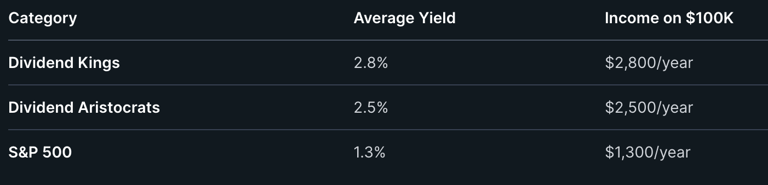
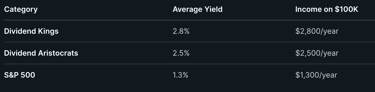
Kings edge out Aristocrats on dividend yields by about 30 basis points. The average King yields around 2.8% compared to 2.5% for Aristocrats, though both categories crush the S&P 500's typical 1.3% yield.
Yield is kind of low? I know... But there are higher ones that ar not kings or aristocrats actually!
Check them out here: Dividend Yield.
Why do Kings yield more? Many include smaller companies outside the S&P 500 that trade at more attractive valuations. Aristocrats skew toward larger caps that often carry premium pricing, which compresses yields.
Your dividend income stream grows faster with Aristocrats in the early years thanks to their slightly higher growth rates. But Kings' higher starting yields mean you collect more cash upfront while still enjoying solid dividend growth streaks.
Dividend Safety and Track Record
Here's where Kings flex their royal authority. The probability of a dividend cut among Kings sits around 1% annually compared to 2% for Aristocrats. Both numbers embarrass the S&P 500's 5% cut rate, but that 50% difference between Kings and Aristocrats isn't trivial.
Dividend safety scores favor Kings because their dividend history spans more economic cycles. A King that raised dividends through the 1973-74 recession, Black Monday 1987, and the savings-and-loan crisis has demonstrated dividend reliability that no 25-year streak can match.
Payout ratios run similar between both groups, typically ranging from 40-60% of earnings. Lower payout ratios indicate more cushion for maintaining consistent dividend increases even when profits stumble.
The dividend track record of Kings includes surviving events that today's newer Aristocrats never faced. That matters when you're building a portfolio meant to fund retirement income for 30+ years.
Popular Stocks and Sector Diversity
Both categories feature household names you'd recognize from your shopping trips and medicine cabinet. Kings lean heavier into consumer staples and utilities, while Aristocrats spread out across more sectors including technology and financials.
Notable Dividend Kings and Aristocrats
You'll find some of the most boring, reliable companies in America on these lists. Procter & Gamble (PG) leads the Kings with 68 years of raises, selling you the same soap and toothpaste your grandparents used.
Coca-Cola (KO) and PepsiCo (PEP) have both raised dividends for 62+ years by convincing billions of people that sugary water is worth $2 a bottle. Johnson & Johnson (JNJ) hit 62 years before its recent split into different companies.
3M (MMM) boasts 65 years of increases despite making everything from Post-it Notes to industrial adhesives. McDonald's (MCD) reached 48 years as an Aristocrat, proving that fries and burgers never go out of style.
Other Kings include Lowe's (LOW) at 61 years, Hormel Foods (HRL) at 58 years (thank you, SPAM), and water utilities like American States Water (AWR) at 69 years and California Water Service (CWT) at 57 years. Abbott Laboratories (ABT) and AbbVie (ABBV) both inherited their streaks from Abbott's 2013 split.
Top Sectors and Industry Representation
Consumer staples dominate both lists, making up 24% of Aristocrats and 28% of Kings. This sector includes companies like Walmart (WMT), Target (TGT), Kimberly-Clark (KMB), and Sysco (SYY) that sell things people need regardless of economic conditions.
Industrials take the second spot at 22% for Aristocrats and 24% for Kings. This includes Emerson Electric (EMR), Stanley Black & Decker (SWK), and manufacturers like Nucor (NUE) and Fuller Company (FUL).
Financials represent 13-15% across both lists, featuring insurance companies like RLI Corp (RLI) and Cincinnati Financial (CINF). Utilities grab 7% of Aristocrats but 13% of Kings, reflecting how water and gas companies build decades-long track records.
Real estate has a smaller presence with REITs like Federal Realty (FRT).
The Dividend Aristocrats list includes more growth sectors like technology that the Dividend Kings list lacks entirely due to the 50-year requirement.
Aristocrats and Kings in Consumer Staples and Utilities
The consumer staples and utilities sector represent the most stable sectors where companies maintain pricing power during recessions. Your toilet paper budget doesn't change much whether the economy booms or crashes.
Consumer staples Kings include Colgate-Palmolive (CL) at 61 years and Procter & Gamble (PG) at 68 years. These companies own brands you buy without thinking: Tide, Crest, Bounty, Charmin.
Utilities excel at dividend consistency because they operate as regulated monopolies. Northwest Natural (NWN) has raised dividends for 67 years providing natural gas. SJW Group (SJW) and Farmers & Merchants Bancorp (FMCB) serve specific regions with essential services.
Water utilities like American States Water (AWR) and California Water Service (CWT) benefit from contracts and rate structures that guarantee revenue. People pay their water bills even when they skip other payments.
Strategies for Building a Dividend-Focused Portfolio
You can't just throw darts at a list of Dividend Kings and call it a day. Building a dividend portfolio that generates passive income requires balancing safety with growth and knowing when to use ETFs versus individual stock picks.
BLT: Blending Kings, Aristocrats, and Growth Stocks
The BLT approach gives you the best of all worlds without putting all your eggs in one basket. Start with 40-50% of your dividend portfolio in Dividend Kings for maximum safety. These are your anchors like Procter & Gamble and Johnson & Johnson.
Add 30-40% in Dividend Aristocrats that aren't Kings yet. Companies like AbbVie and McDonald's offer higher growth potential while still maintaining 25+ year track records. They're the sweet spot between safety and upside.
Round out the final 10-20% with dividend growth stocks that have shorter streaks but faster dividend growth rates. Think Microsoft or Visa, which grow dividends at 10%+ annually versus the 5-7% typical of Kings.
This mix protects you during market crashes while capturing growth when times are good. Your Kings won't make you rich overnight, but they won't break your heart either.
Investing via ETFs and Index Funds
The NOBL ETF tracks the S&P 500 Dividend Aristocrats index and charges a 0.35% expense ratio. It's the lazy way to own all 68 Aristocrats without picking individual stocks. You get instant diversification and automatic rebalancing every January.
The downside? NOBL doesn't include Dividend Kings that sit outside the S&P 500. You also can't overweight your favorite dividend stocks or exclude ones you don't like.
For pure Kings exposure, no widely-traded ETF exists. You'll need to build that position yourself using individual stocks. Some investors split their approach: buy NOBL for Aristocrats coverage, then add 5-10 individual Dividend Kings on top.
Index funds offer lower fees but less flexibility. Pick ETFs if you value convenience over control.
Rebalancing and Dividend Reinvestment Approaches
Set up a DRIP (dividend reinvestment plan) to automatically buy more shares with your dividends. This compounds your returns without you lifting a finger. Most brokers offer commission-free DRIP programs.
Rebalance your dividend portfolio once or twice per year, not every week. Check if any position has grown beyond 10% of your total portfolio. Trim it back and redirect the cash to underweight positions.
Your liquidity requirements matter too. If you need the passive income now, take the cash distributions instead of reinvesting. If retirement is 10+ years away, reinvest everything and let compounding work its magic.
Watch for dividend cuts during rebalancing. If a King or Aristocrat freezes or cuts its dividend, sell it immediately. The streak is broken and the investment thesis is dead. Replace it with stock ideas from companies still raising payouts.
Conclusion
You've made it through the royal court of dividend investing. Now you know that Dividend Aristocrats need 25 years of raises while Kings need 50. Think of it this way: Aristocrats are impressive, but Kings have survived disco, the fall of the Berlin Wall, and several questionable fashion trends.
The good news? You don't have to pick sides in this royal rivalry.
The smartest move is building a portfolio that includes both:
Core Kings like Procter & Gamble and Coca-Cola for rock-solid stability
Growth Aristocrats like AbbVie and McDonald's for higher upside potential
A mix that matches your risk tolerance and income needs
Your choice depends on what you value most. Want maximum safety and the longest track records? Load up on Kings. Want broader diversification and easier access through ETFs? Aristocrats are your friend.
The truth is, both categories have crushed the market while protecting you during downturns. They've delivered higher returns with less drama than the S&P 500. That's not a bad deal.
Start tracking a few companies from each list. Watch their payout ratios, dividend growth rates, and yields. Build your position slowly. Let time and compounding do the heavy lifting while you sleep.
Your future self will thank you for choosing companies that have proven they can survive anything the market throws at them.
Contact
kbgholston445@gmail.com
© 2025. All rights reserved.