Stock Rover vs. Seeking Alpha: The Comparison Most Reviews Get Completely Wrong
Most head-to-head comparisons treat these two platforms like they're competing for the same job. They're not. Understanding what each one actually does — and doesn't do — is the difference between building a research system that works and paying for tools that overlap, contradict each other, or quietly leave gaps in your analysis. Here's the honest breakdown.
6/11/20267 min read


In a nut shell, Stock Rover works best for investors who want to analyze stocks using detailed financial metrics and custom screens, while Seeking Alpha suits those who prefer reading diverse investment opinions and community-driven research. The platforms cost different amounts and serve different needs. Stock Rover runs from $8 to $28 per month with more features at higher tiers. Seeking Alpha charges $299 per year for Premium or $2,400 annually for Pro access.
Your choice depends on how you like to research stocks. If you want to build your own analysis using hundreds of financial metrics and screening options, Stock Rover gives you those tools. If you'd rather read what other investors think and see crowdsourced ratings, Seeking Alpha provides that perspective. Both platforms offer free versions so you can test them before paying.
Key Takeaways
Stock Rover excels at data-driven analysis with over 700 metrics while Seeking Alpha focuses on crowdsourced investment articles and ratings
Stock Rover costs $8-$28 monthly for North American markets while Seeking Alpha charges $299-$2,400 yearly with global coverage
Your best choice depends on whether you prefer analyzing raw financial data yourself or reading diverse investment perspectives from contributors
Core Differences and Target Users


Stock Rover and Seeking Alpha take fundamentally different approaches to investment research, with Stock Rover emphasizing data-driven metrics and Seeking Alpha focusing on community insights and analyst opinions. Understanding these core differences helps you match your investing style with the right platform.
Platform Philosophies
Stock Rover operates as a quantitative research tool built around metrics and data visualization. The platform provides access to over 700 metrics for fundamental analysis, letting you screen stocks based on specific financial criteria. You get detailed charts, heat maps, and customizable views that transform raw data into visual insights. Stock Rover focuses on giving you the numbers and tools to make your own investment decisions.
Seeking Alpha takes a community-driven approach to stock research platforms. The platform combines proprietary Quant Ratings with analysis from financial experts and community contributors. You access thousands of articles, earnings call transcripts, and expert opinions rather than just raw metrics. Seeking Alpha's philosophy centers on learning from collective wisdom and expert analysis alongside quantitative ratings.
Intended Investor Profiles
Stock Rover targets active investors and advanced investors who prefer independent analysis. The platform works best if you understand financial metrics and want to dig deep into company fundamentals. You need comfort with complex data sets and the ability to interpret multiple metrics simultaneously. Stock Rover suits investors who build their strategies around specific screening criteria and custom portfolio analysis.
Seeking Alpha serves a broader range of investors, from beginners to professionals. The platform helps new investors learn through community content and expert analysis while providing advanced tools for experienced traders. You benefit most from Seeking Alpha if you value diverse perspectives and want access to detailed research reports. The platform works well for investors who combine fundamental analysis with expert opinions and market sentiment.
Ease of Use and Learning Curve
Stock Rover presents a steeper learning curve with a more complex interface. The dashboard shows multiple data points, charts, and metrics that can overwhelm new users. Load times sometimes lag when accessing certain features. However, once you learn the system, the navigation becomes straightforward and the visualizations prove valuable for portfolio management.
Seeking Alpha offers a cleaner, more intuitive interface that beginners can navigate easily. The customizable dashboard lets you choose which modules appear on your home screen. The platform loads quickly and organizes information in an accessible way. You can start using basic features immediately while gradually exploring more advanced tools as your experience grows.
In-Depth Feature Comparison


Both platforms excel in different areas: Stock Rover in customizable analytics and portfolio management, Seeking Alpha in research depth and community insights.
Portfolio Management and Analytics
Both Stock Rover and Seeking Alpha let you track your portfolio, but they serve different types of investors.
Stock Rover is built for investors who want detailed data and deeper analysis. You can connect accounts from over 1,000 brokerages and track multiple portfolios in one place. The platform helps you spot overlapping investments, estimate future dividend income, and measure risk using advanced tools.
Some of its most useful features include:
Automatic brokerage syncing
Future dividend income projections
Portfolio diversification analysis
Sector and geographic allocation breakdowns
Portfolio rebalancing tools (Premium Plus)
Tax-loss harvesting suggestions (Premium Plus)
Stock Rover also lets you compare your portfolio against benchmarks, track performance over time, and receive alerts for dividend announcements, earnings reports, and major price movements.
Seeking Alpha takes a simpler approach.
Its portfolio tracker syncs with major brokerages and focuses on the metrics most investors care about, such as total return and dividend income. You can also receive alerts whenever analysts publish new research on stocks you own.
Seeking Alpha Premium adds a Portfolio Health Score, which evaluates your holdings using the platform's Quant Ratings system.
Unlike Stock Rover, Seeking Alpha isn't designed for deep portfolio analytics. You won't find advanced tools like diversification analysis, portfolio simulations, or rebalancing recommendations. Instead, its strength is research. You can quickly access multiple expert opinions on each stock and see how analyst ratings change over time.
Bottom line: If you want detailed portfolio analysis and planning tools, Stock Rover is the stronger choice. If your priority is stock research and investment ideas, Seeking Alpha is the better fit.
Screening Tools and Customization
Stock Rover's stock screener provides access to 700+ financial metrics on Premium Plus, with the ability to screen on historical data going back 10 years. You can create equation screening with custom formulas, ranked screening with weighted criteria, and save unlimited screens. The platform includes over 140 pre-built screeners organized by investment strategy.
The screener covers North American stocks, mutual funds, and ETFs. You can filter by fundamental data like P/E ratios, revenue growth, and profit margins, then rank results by custom criteria. The interface resembles a spreadsheet, allowing you to add or remove columns and export data.
Seeking Alpha's screening tools includes built-in stock and ETF screening tools that help investors find opportunities without spending hours researching.
One of its biggest strengths is that it combines several rating systems into a simple scorecard. You can filter stocks based on factors such as:
Value
Growth potential
Profitability
Momentum
Earnings revisions
For ETF investors, the platform also provides fund-specific screening metrics to help compare different funds more effectively.
If you're not sure where to start, Seeking Alpha offers ready-made screens such as:
Top Growth Stocks
Dividend Aristocrats
High Dividend Stocks
Top-Rated ETFs
The platform is easier to learn than Stock Rover, making it a good option for beginners. While it doesn't offer as many customization options, it allows you to quickly filter stocks using:
Analyst ratings
Investor sentiment
Quant Ratings
Proprietary Seeking Alpha scores
Another advantage is that every screening result links directly to additional research. You can immediately access stock analysis articles, earnings call transcripts, analyst opinions, and news updates without leaving the platform.
Bottom line: Seeking Alpha's screener is designed for investors who want fast stock ideas and easy-to-understand ratings, while Stock Rover is better suited for those who want deeper customization and more advanced analysis tools.
Research Quality and Data Depth
Stock Rover provides raw fundamental data without interpretation. You get 10 years of historical data on Premium and Premium Plus, covering income statements, balance sheets, and cash flow statements. Financial metrics include standard ratios, growth rates, and efficiency measures. The platform doesn't offer stock research reports in the traditional sense.
Stock Rover focuses on giving you the tools to do your own research. Charts display historical trends, and you can compare metrics across multiple companies. The Research Reports add-on ($49.99/year) provides pre-written analysis, but this is separate from the core platform.
Seeking Alpha excels at research depth through its contributor base of over 18,000 analysts. You get multiple perspectives on individual stocks, from bullish to bearish viewpoints. Articles include detailed investment theses, financial analysis, and sector commentary. Seeking Alpha Premium provides unlimited access to this content.
The platform's Quant Ratings analyze over 100 financial metrics per stock. Alpha Picks delivers two monthly stock picks based on quantitative analysis. Seeking Alpha Pro ($2,400/year) adds short ideas, top idea lists, and priority access to new research. Earnings call transcripts are available for thousands of companies.
Pricing, Plans, and Add-ons
Stock Rover uses tiered monthly pricing:
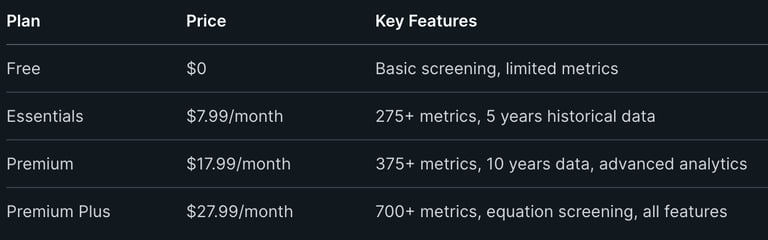
Annual plans save the equivalent of two months. Research Reports cost an additional $49.99/year. Stock Rover offers a free trial for paid plans.
Seeking Alpha charges annually:
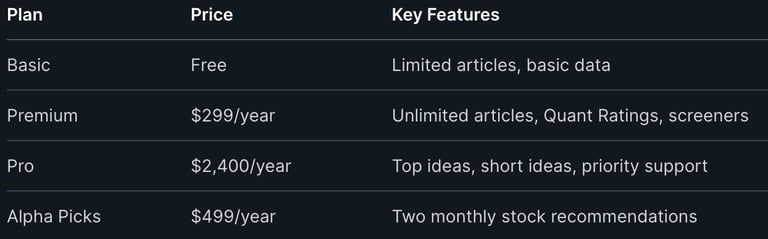
Seeking Alpha Premium is the entry point for most serious investors. The free plan restricts article access and lacks portfolio analytics. Monthly payment options are available at higher rates than annual subscriptions.
Conclusion
Stock Rover and Seeking Alpha serve different types of investors with distinct approaches to stock research.
Stock Rover is built for investors who want to analyze data themselves. It offers over 700 financial metrics, powerful screening tools, and detailed portfolio analytics. The platform works best if you have the time and knowledge to work with complex data sets. However, it focuses mainly on North American markets and has a steep learning curve that can slow you down.
Seeking Alpha takes a different path by providing analysis from thousands of contributors. You get access to diverse perspectives, Quant Ratings, and detailed investment theses on companies. The platform is useful for reading what other investors think. The downside is that article quality varies widely, and you'll often find conflicting opinions with no clear way to judge which contributors actually know what they're doing.
Your choice depends on how you prefer to research stocks:
Choose and click; Stock Rover if you want to build your own analysis using deep financial data
Choose and click; Seeking Alpha if you prefer reading analysis from multiple contributors
Both platforms require significant investment in either money or time. Stock Rover demands $8-$28 per month depending on features needed. Seeking Alpha costs $299 per year for Premium access.
Consider trying the free versions of each platform to see which approach fits your investment style before committing to a paid subscription.
Contact
kbgholston445@gmail.com
© 2025. All rights reserved.