How to Build a Dividend Portfolio in One Afternoon (No Stock Picking Required)
Most people put off dividend investing because they think it requires months of research, a finance degree, or thousands of dollars to get started. It doesn't. In the time it takes to watch a Netflix episode, you can build a complete dividend portfolio — one that pays you regularly, grows over time, and requires almost zero ongoing effort.
5/5/20269 min read


Dividend investing lets you build passive income without needing to pick individual stocks or time the market. Starting with dividend ETFs gives you instant diversification across dozens or hundreds of companies that pay regular income, reducing your risk while you learn the basics. Instead of researching individual companies for weeks, you can build a complete dividend portfolio in an afternoon using just two or three ETFs.
You don't need thousands of dollars to start. Many brokers now offer fractional shares and automatic dividend reinvestment at no cost, which means even $100 can get you started. The key is choosing the right mix of dividend ETFs that balance current income with future growth, then setting up automatic contributions so your portfolio builds itself over time.
This blueprint walks you through the exact steps to build your first dividend portfolio using ETFs. You'll learn which funds to buy, how much to allocate to each, and how to set up automatic reinvestment so your dividends compound without extra work on your part.
Key Takeaways
Dividend ETFs provide instant diversification and regular passive income without requiring individual stock research
Setting up automatic contributions and dividend reinvestment creates compounding growth that accelerates over time
A simple three-ETF portfolio balancing yield, growth, and stability works better for beginners than chasing high-yield investments
Foundations of Dividend Investing
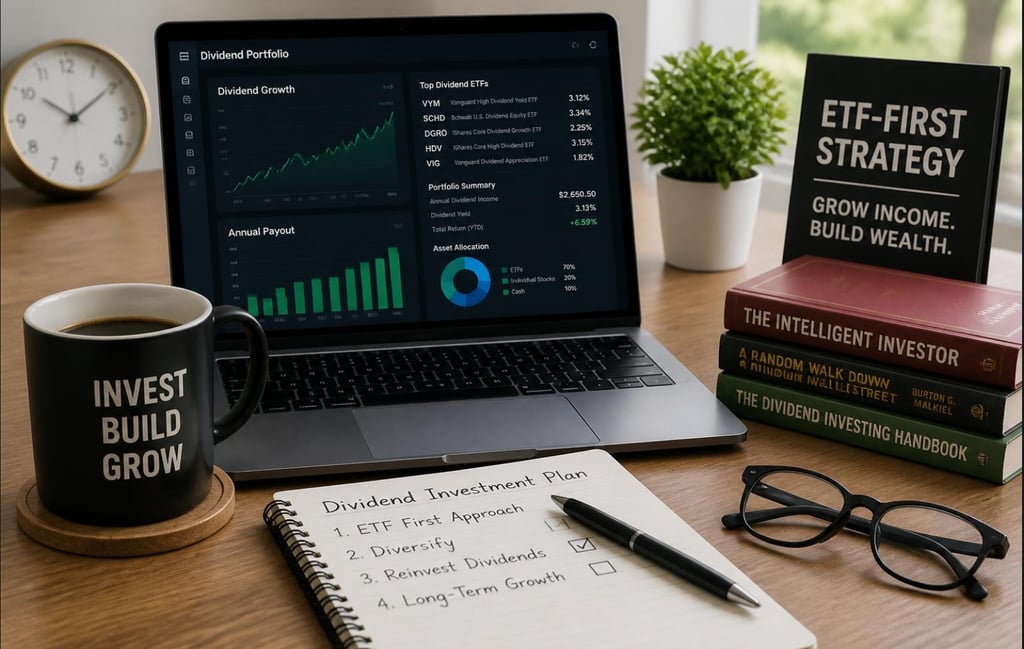
Dividend investing lets you earn regular income from companies that share profits with shareholders. Understanding how dividends work, the difference between stocks and ETFs, and how reinvestment builds wealth over time forms the base for any successful portfolio.
Why Dividends Matter for Beginners
Dividends provide cash payments directly to your account, usually every quarter. You don't need to sell shares to generate income, and you don't need to predict which stocks will surge next month.
Companies that pay dividends tend to be established and financially stable. They have consistent earnings and a track record of sharing profits. This makes dividend stocks less volatile than companies that reinvest everything into growth.
The numbers tell a clear story. Since 1930, reinvested dividends have made up roughly 40% of the S&P 500's total return. That means nearly half of the stock market's gains came from dividends compounding over time, not just from rising share prices.
You receive income whether the market goes up or down. This steady cash flow helps you stay calm during downturns and gives you a clear reason to hold your investments long term.
Breaking Down Dividend Stocks and ETFs
Dividend stocks are shares in individual companies that pay regular dividends. Examples include Procter & Gamble, Coca-Cola, and Johnson & Johnson. Buying individual stocks gives you control over exactly which companies you own, but it also carries more risk. A single company can cut or eliminate its dividend at any time.
Dividend ETFs (exchange-traded funds) hold dozens or hundreds of dividend-paying stocks in one fund. When you buy one share of a dividend ETF, you own a piece of every company in that fund. This instant diversification protects you if any single company cuts its payout.
For beginners, ETFs make more sense than picking individual stocks. You avoid the risk of putting too much money into one company, and you don't need to research dozens of financial statements. Popular dividend ETFs include SCHD, VYM, and VIG, each holding between 40 and 400 dividend-paying companies.
The Role of Dividend Growth and Yield
Dividend yield shows how much income you earn relative to the share price. You calculate it by Annual dividends ➗ The Current Stock Price. A $100 stock paying $3.50 per year has a 3.5% dividend yield.
Dividend growth rate measures how fast a company increases its dividend each year. A stock with a 2.5% yield growing at 10% annually will surpass a static 5% yield within a decade.
Beginners often chase high yields above 8% or 10% or more. This is a mistake. Extremely high yields usually signal financial trouble, and the company often cuts the dividend soon after.
Focus on dividend growth over starting yield. A growing dividend compounds faster, raises your yield on cost over time, and indicates a healthy company with rising profits. SCHD, for example, has increased its dividends at roughly 12% annually over the past five years.
How Dividend Reinvestment Fuels Compound Growth
Dividend reinvestment (DRIP) automatically uses your dividend payments to buy more shares. Instead of receiving cash, your brokerage purchases additional shares the moment dividends arrive. This creates a compounding cycle: your dividends buy shares, those shares pay more dividends, and the cycle accelerates.
Most brokers including Fidelity, Charles Schwab, and Vanguard offer free automatic DRIP with fractional shares. Every dividend payment buys more shares down to the penny, with no trading commissions.
The compounding effect becomes powerful over time. If you invest $10,000 at a 3.5% yield with 7% dividend growth and reinvest everything, you could generate over $1,000 per month in dividend income after 15 years. Without reinvestment, that same portfolio would produce far less.
Early in your investing journey, reinvest every dividend. The snowball needs time to build. Once your portfolio generates enough income to cover your expenses, you can switch to taking dividends as cash.
How to Start Your Dividend ETF Portfolio
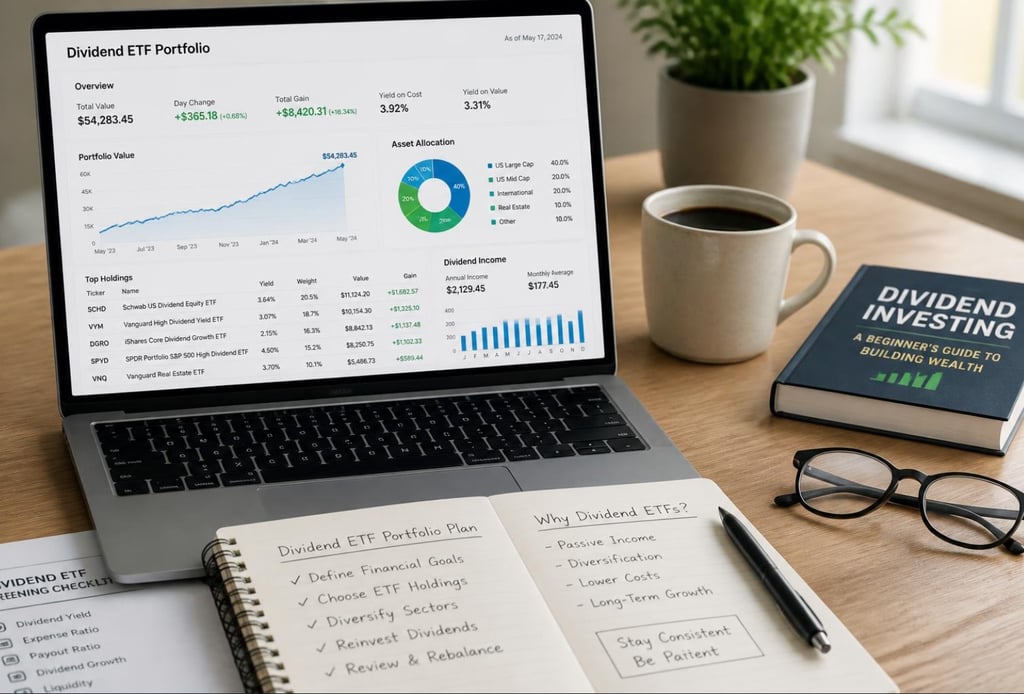
Starting a dividend ETF portfolio requires four key decisions: where to invest, which funds to buy, how to spread your money across different assets, and what account type gives you the best tax advantages. Getting these basics right from day one sets you up for long-term success.
Opening a Brokerage Account and Setting Up DRIP
You need a brokerage account before buying any dividend ETFs. Fidelity, Vanguard, and Charles Schwab all offer commission-free ETF trades, which means you won't pay fees when buying or selling. These brokers also provide fractional share investing, letting you put every dollar to work even if you can't afford full shares.
Set up automatic dividend reinvestment (DRIP) as soon as you open your account. DRIP takes every dividend payment and automatically buys more shares of the same fund. This happens at no cost to you and keeps your money working instead of sitting idle in cash.
Most brokers let you enable DRIP with a single checkbox in your account settings. Turn it on for all your dividend ETFs. This small step is what makes compounding work over time.
Choosing Core Dividend ETFs (SCHD, VIG, VYM, and More)
SCHD (Schwab U.S. Dividend Equity ETF) focuses on high-quality dividend growth stocks with strong financials. It yields around 3.5% and has grown its dividend by roughly 12% annually over the past five years. This fund makes an excellent core holding.
VIG (Vanguard Dividend Appreciation ETF) owns companies that have increased dividends for at least 10 consecutive years. It yields lower at 1.8-2.2%, but emphasizes quality and dividend growth over current income.
VYM (Vanguard High Dividend Yield ETF) tracks the highest-yielding stocks in the market, offering 3.0-3.8% yield with exposure to over 400 companies. It provides broader diversification than SCHD.
A simple starting allocation might put 60% in SCHD, 20% in VIG, and 20% in a bond ETF like BND. This gives you solid dividend income, growth potential, and some stability from bonds.
Check out this article to learn more about which ETFs to get started with!
Portfolio Diversification Strategies for Stability
Diversification means spreading your money across different types of investments so one bad event doesn't wreck your entire portfolio. Dividend ETFs already give you built-in diversification since each fund holds dozens or hundreds of stocks.
You still need diversification across fund types. Mixing dividend growth ETFs (like VIG) with high-yield funds (like VYM) and adding bonds creates balance. If stock prices drop, bonds often hold steady or rise, cushioning your losses.
Don't put everything into one ETF, even a good one. Split your money among at least two or three funds. This protects you if one fund's strategy underperforms or if a specific market sector struggles.
Using Roth IRA and Tax-Advantaged Accounts
A Roth IRA is one of the best accounts for dividend investing. You contribute after-tax money, but all your dividends and growth become completely tax-free forever. When you retire and start withdrawing money, you pay zero taxes.
Regular brokerage accounts tax your dividends every year, which slows your compounding. A Roth IRA lets every dividend reinvest at full value with no tax bill eating into your returns.
The 2026 Roth IRA contribution limit is $7,000 per year ($8,000 if you're 50 or older). If your income is too high to contribute directly, look into a backdoor Roth IRA conversion. Many brokers, including Fidelity and Vanguard, make this process straightforward.
Automatic Investing and Dollar-Cost Averaging
Set up automatic monthly investments to build your portfolio without thinking about market timing. Dollar-cost averaging means you invest the same amount on a regular schedule, buying more shares when prices are low and fewer when prices are high.
This approach removes emotion from investing. You don't need to guess if the market will go up or down next month.
Most brokers let you automate purchases of dividend ETFs. Start with whatever amount fits your budget, even if it's just $50 or $100 per month. The key is consistency.
Enable dividend reinvestment (DRIP) through your brokerage account. This automatically uses your dividend payments to buy more shares. Your passive income compounds faster when dividends purchase additional shares that generate their own dividends.
Evaluating Payout Ratios and Ex-Dividend Dates
The payout ratio shows what percentage of a company's earnings goes toward dividends. A ratio above 80% suggests the dividend might not be sustainable. Most healthy dividend payers maintain ratios between 40% and 70%.
Check payout ratios every quarter for your ETF holdings. ETF providers list this information in their fact sheets or holdings reports.
The ex-dividend date determines who receives the next dividend payment. You must own shares before this date to get paid. If you buy on or after the ex-dividend date, the previous owner gets that dividend.
Plan your purchases around these dates when adding to positions. Buying just after an ex-dividend date often means getting a slightly lower price since the stock drops by roughly the dividend amount.
Tracking Yield, Growth, and Portfolio Performance
Monitor three key metrics quarterly. Your current dividend yield shows annual income divided by your portfolio value. The dividend growth rate tells you how much companies are increasing their payments each year. Total return combines dividend income plus share price changes.
Key metrics to track:
Dividend yield: Should stay within your target range
Dividend growth rate: Look for annual increases of 5-10% or higher
Total return: Compare against your benchmark index
Create a simple spreadsheet to log your quarterly dividend payments. Watch for any cuts or freezes in distributions. A single missed or reduced payment from an ETF signals problems with underlying holdings that need investigation.
Your passive income should increase each year through both new contributions and dividend growth. If your income stays flat or drops, review your ETF choices and rebalance toward funds with stronger dividend growth rates.
Chasing High Yields vs. Sustainable Growth
A 10% dividend yield might look attractive, but it usually signals a company in financial distress whose stock price has collapsed. When you chase these high yields, you risk owning a stock that cuts or eliminates its dividend entirely.
Dividend growth matters more than starting yield. A stock yielding 2.5% that grows its dividend by 10% annually will surpass a stagnant 5% yielder within seven years. This is the core principle behind dividend growth investing.
Diversification protects you when individual stocks disappoint. ETFs like SCHD hold 100+ dividend-paying companies across multiple sectors. If one company cuts its dividend, the impact on your total portfolio remains minimal.
The Importance of Patience and Long-Term Mindset
Your dividend portfolio will face market downturns. Stock prices will drop 20%, 30%, or more during recessions. This is normal and expected.
The critical insight: your dividend income keeps flowing even when share prices fall. Quality dividend stocks maintain or even increase their payouts during downturns. Selling during these periods locks in losses and destroys the compounding that makes dividend investing powerful.
Set up automatic monthly investments and forget about daily price movements. Your $500 monthly contribution buys more shares when prices are low and fewer when prices are high. This dollar-cost averaging smooths out volatility automatically.
Turn on dividend reinvestment and leave it on for at least 10 years. The first five years of dividend investing feel slow because your income is small. But the compounding accelerates dramatically in years 10-20 as your growing dividend payments buy increasingly more shares.
Conclusion
Building your first dividend portfolio doesn't require perfect timing or complex strategies. You need three things: a clear plan, consistent contributions, and patience to let compound growth work.
Start with 2-4 dividend ETFs that cover different sectors and geographies. This gives you instant diversification without the research burden of individual stocks. Your portfolio should balance current income with growth potential.
The key steps to remember:
Open a brokerage account with low fees
Set up automatic monthly investments
Reinvest dividends during your accumulation phase
You won't build significant income overnight. A $10,000 portfolio yielding 4% generates $400 per year. Growth comes from adding money regularly and giving your investments time to compound.
The ETF-first approach removes the pressure of stock picking while you learn. You can always add individual dividend stocks later as your knowledge and confidence grow.
Your next action is simple: choose your first ETF and make your initial investment. The perfect portfolio doesn't exist, but a good portfolio that you actually start will always beat a perfect plan you never execute.
Focus on progress over perfection.
Small, consistent steps build substantial results over years and decades!
Contact
kbgholston445@gmail.com
© 2025. All rights reserved.