Dividend ETFs vs. Individual Stocks: What the Data Actually Says (Beginners Get This Wrong)
There's no universally "right" answer — but there is a right answer for you. Depending on how much time you have, how much risk you can stomach, and what kind of returns you're targeting, one approach will dramatically outperform the other. Here's how to figure out which one that is, using real performance data.
4/22/20268 min read

For most beginners, dividend ETFs are the better choice because they offer instant diversification, lower risk, and require less time and research than picking individual stocks. This doesn't mean individual stocks are bad. They can work well for experienced investors who have time to research companies and want more control over their investments. But if you're just getting started, ETFs give you a safer path to earning dividend income without needing to become an expert stock picker.
The good news is that you don't have to choose just one approach forever. Many successful investors start with dividend ETFs to build a foundation, then add individual stocks as they learn more and gain confidence. This article will walk you through the key differences between these two options, show you the data on how they perform, and help you figure out which strategy fits your goals and situation.
Key Takeaways
Dividend ETFs provide automatic diversification and lower risk, making them ideal for beginners who want dividend income without extensive research
Individual dividend stocks offer higher potential returns and more control but require significant time, knowledge, and carry greater risk if a company cuts its dividend
Most investors benefit from starting with dividend ETFs and gradually adding individual stocks as they gain experience and confidence
Key Differences Between Dividend ETFs and Individual Stocks


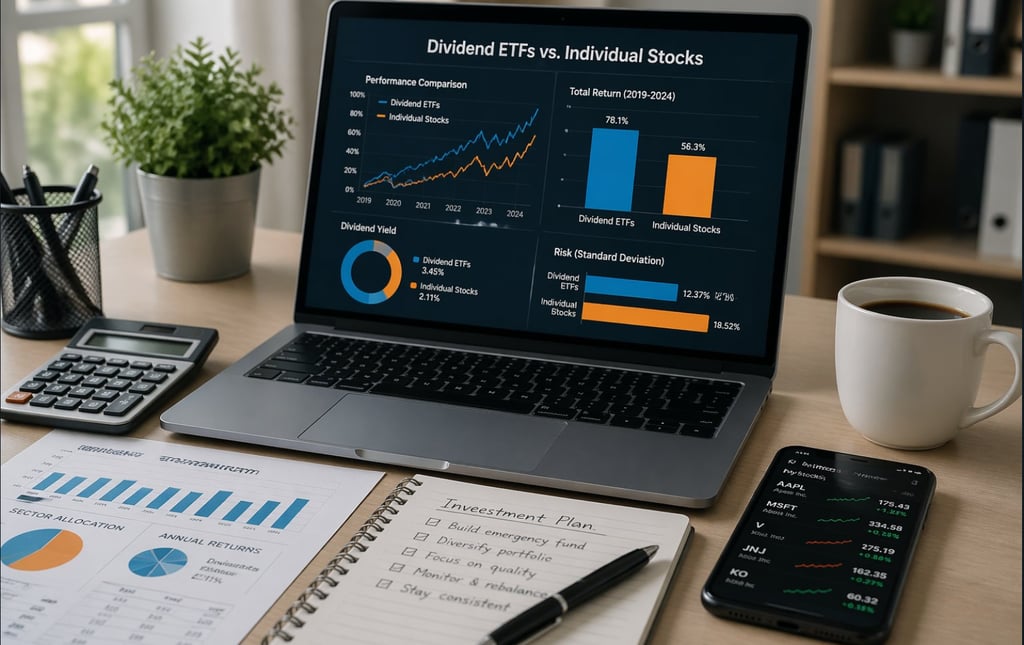
Dividend ETFs and individual stocks work in fundamentally different ways, with each option offering distinct advantages in terms of diversification, cost structure, and the amount of control you have over your investments.
How Dividend ETFs Work
A dividend ETF is a fund that holds a collection of dividend-paying stocks in one package. When you buy shares of a dividend ETF, you're actually buying tiny pieces of dozens or even hundreds of different companies at once.
The ETF tracks an index of dividend stocks automatically. Professional managers or computer algorithms decide which stocks to include based on the index rules. You don't need to research individual companies or make stock picking decisions.
When the companies in the ETF pay dividends, the fund collects that money. The ETF then distributes these dividends to you, usually on a quarterly basis. Many popular dividend ETFs like VIG, SCHD, and VYM have expense ratios around 0.06%, meaning you pay just $6 per year for every $10,000 invested.
Most dividend ETFs trade on exchanges just like stocks. You can buy and sell them through any broker, including Interactive Brokers and other platforms. This makes them just as easy to trade as individual stocks.
How Individual Dividend Stocks Operate
Individual dividend stocks represent ownership in a single company. When you buy shares of one company, you're betting on that specific business to perform well and keep paying dividends.
You need to research each company yourself. This means analyzing financial statements, understanding the business model, and evaluating whether the company can maintain or grow its dividend payments. Many investors use a stock screener to filter through thousands of options and find stocks that meet their criteria.
Companies typically pay dividends every quarter, though some pay monthly or annually. The dividend goes directly to your brokerage account. You have complete control over which stocks to buy, when to sell, and how to manage your portfolio.
Unlike ETFs, individual stocks don't charge ongoing expense ratios. However, you might pay trading commissions depending on your broker. You also need to invest time and effort into monitoring your holdings and making decisions about when to buy or sell.
Diversification and Risk Profiles
Diversification is the biggest difference between these two approaches. A single dividend ETF can hold 50 to 500 different stocks, spreading your money across many companies and sectors. This means if one company cuts its dividend or faces problems, it barely affects your overall returns.
Individual stocks concentrate your risk. If you own just five dividend stocks and one company slashes its dividend by 50%, that decision significantly impacts your income. Building a diversified portfolio of individual stocks requires buying at least 20-30 different companies across various sectors.
ETF diversification benefits:
Automatic sector balance
Protection from single-company failure
No research needed for each holding
Lower volatility than individual stocks
Individual stock concentration risks:
Company-specific problems hit harder
Dividend cuts directly reduce your income
Requires more capital to diversify properly
Higher potential volatility
The trade-off is that individual stocks let you potentially earn higher returns if you pick winners. However, this requires skill, time, and often some luck.
Costs and Fees in Each Approach
Dividend ETFs charge annual expense ratios that range depending on the fund. These fees are automatically deducted from the fund's assets. A $10,000 investment in an ETF with a 0.06% expense ratio costs you $6 per year.
Individual stocks don't have ongoing management fees. Once you buy a stock, you own it without paying annual charges. However, you pay trading commissions each time you buy or sell. Some brokers charge per-share fees, while others offer commission-free trading.
Building a diversified portfolio of individual stocks can be expensive if you're buying small amounts. If you invest $500 into 20 different stocks, you're making 20 separate purchases. Even with free trades, the bid-ask spread on each transaction adds up.
Cost comparison example:
ETF: $10,000 investment × 0.06% = $6/year
Individual stocks: $0 ongoing fees, but 20 trades × $5 commission = $100 upfront
Tax efficiency also matters. ETFs are generally more tax-efficient because you control when you sell. With individual stocks, you need to manage tax-loss harvesting and dividend taxes yourself. Some investors who track real money portfolios find that the time spent managing individual stocks costs more than ETF fees when you factor in the value of their time.
Performance Metrics and Analytical Tools
When evaluating dividend ETFs versus individual stocks, you need to understand key financial metrics and how to use screening tools to compare them. The right analytics help you make informed decisions based on actual data rather than guesswork.
Comparing ROI, ROE, and P/E Ratio
ROI (Return on Investment) shows how much money you've made compared to what you put in. For dividend stocks, this includes both price appreciation and dividend payments. ETFs typically show steadier ROI over time, while individual stocks can swing more dramatically.
ROE (Return on Equity) measures how well a company uses shareholder money to generate profits. You'll want to look for individual dividend stocks with ROE above 15%. ETFs don't have a single ROE number since they hold multiple companies, so you need to check the weighted average of their holdings.
The P/E ratio (Price-to-Earnings) tells you how much you're paying for each dollar of earnings. A lower P/E might mean a stock is undervalued, while a higher P/E could signal overvaluation. Dividend stocks often have P/E ratios between 15-25. You can compare an ETF's average P/E ratio against its benchmark index to see if it's trading at a premium or discount.
Using Fundamental Screening and Portfolio Analytics
Fundamental screening tools let you filter stocks based on criteria like dividend yield, payout ratio, and debt levels. You can screen for stocks with 5+ years of dividend growth or P/E ratios under 20. Most brokerage platforms offer basic screeners for free.
Portfolio analytics software tracks your holdings' performance and risk exposure. These tools show sector concentration, correlation between assets, and income projections. Some advanced platforms offer features like institutional ownership data, which reveals how many big investors hold a stock. The Atlas Score and similar ratings combine multiple metrics into one number for easier comparison.
Real-time dark flow tracking monitors trades happening in dark pools (private exchanges where large investors trade). This data helps you spot unusual buying or selling activity before it shows up in regular price movements. Tools like TradeGPT use AI trading agents to analyze these patterns, though beginners should focus on basic fundamentals first before diving into complex analytics.
A bit much ? No worries, I've drafted a whole blog on which ETFs to get started with!
Brokerage and Execution Considerations
Your brokerage choice affects your returns through fees and available investment options. Fidelity offers commission-free trades on stocks and ETFs, which helps when you're building a dividend portfolio with multiple positions. Interactive Brokers provides access to international markets if you want to diversify beyond U.S. dividend payers.
Look for brokers with dividend reinvestment plans that don't charge fees. Some alternatives charge for this service, which cuts into your compounding returns over time.
The platform interface matters too. You want easy access to dividend calendars, tax documents, and research reports. Most major brokers now offer mobile apps that let you monitor your portfolio and execute trades anywhere.
Choosing the Right Strategy for Your Investment Goals
Your choice between dividend ETFs and individual stocks should match your experience level, available time, and how you want to participate in market movements. Beginners typically benefit from ETFs, while those with more time and higher risk tolerance might explore individual stocks.
Suitability for Beginners
Dividend ETFs work better if you're just starting out. You get instant access to dozens or hundreds of dividend-paying companies without needing to research each one. This matters because picking individual stocks requires understanding financial statements, company news, and industry trends.
With an ETF, professional managers handle the stock selection. You avoid the risk of putting too much money into one company that cuts its dividend. The learning curve is gentler because you don't need to track multiple earnings reports or worry about company-specific problems.
Individual stocks make sense once you've built up knowledge and confidence. You'll need to commit time to research and monitoring. Many experienced investors start with ETFs and gradually add individual stocks to their portfolios as they learn. This approach lets you manage real money portfolios while reducing the chance of costly mistakes early on.
Risk Appetite and Time Commitment
Your risk tolerance determines which path fits better. Individual dividend stocks carry higher company-specific risk. A single bad earnings report or dividend cut can hurt your returns significantly.
If you have limited time, ETFs require less maintenance. You won't spend hours analyzing financial reports or tracking news for multiple companies. Day trading individual stocks demands constant attention and quick decisions, which most beginners should avoid.
Higher institutional ownership in a stock often signals stability, but it doesn't eliminate risk. Even well-known dividend payers can underperform or reduce payouts during tough times. ETFs spread this risk across many holdings, so one company's problems won't derail your entire investment.
Aligning With Market Trends and Institutional Behavior
Dividend ETFs automatically adjust to sector rotation as fund managers rebalance holdings. When certain industries become more attractive, the ETF shifts gradually without you making any decisions. This helps you stay aligned with broader market trends.
Individual stock investors must track sector rotation themselves. You need to recognize when industries are gaining or losing favor with institutional investors. This takes research skills and market knowledge that most beginners lack.
Institutional ownership patterns can guide your stock picks, but following these moves requires dedication. Large investors often shift positions based on complex strategies that aren't obvious to individual investors. ETFs capture these institutional preferences automatically through their index-tracking approach.
Final Verdict: Don’t Choose One — Build the Right Order
Here’s the mistake most beginners make:
They try to pick the best option between dividend ETFs and individual stocks…
when the real answer is using both — in the right order.
If you’re just starting out, this is your unfair advantage:
Start with dividend ETFs → instant diversification, low fees, fewer mistakes
Add ETFs for income focus → higher yield, still diversified
Then layer in individual stocks → control, upside, optimization
That’s how you build income without blowing up your portfolio early.
What Actually Matters (And Most People Miss)
Your results won’t come from picking the “perfect” ETF or stock.
They come from:
Staying invested
Avoiding costly mistakes
Keeping fees low
Letting compounding do the work
And the fastest way to mess that up?
Jumping into individual stocks too early with no system.
Your Next Step (Do This Now)
If you’re serious about building dividend income:
Start with a low-cost dividend ETF as your base
Use a portfolio tracker to monitor income and performance
Only add individual stocks once you understand:
Cash flow
Dividend safety
Balance sheets
Contact
kbgholston445@gmail.com
© 2025. All rights reserved.