Dividend Investing Isn't Passive Income. Until You Do These 3 Things — Then It Is.
Most beginners buy a few dividend stocks, wait for the paycheck, and wonder why it never quite works the way they expected. Real dividend income — the kind that's reliable, growing, and actually passive — requires getting three things right upfront. Do that once, and the portfolio genuinely runs itself.
6/8/20268 min read
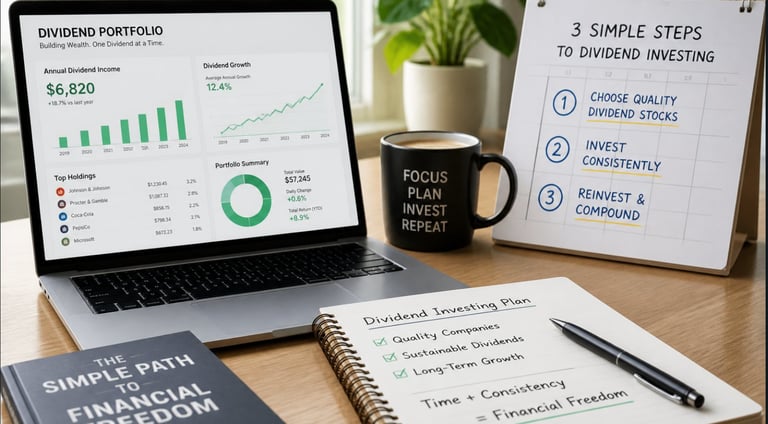
Dividend investing boils down to three straightforward steps: open an investment account, pick dividend-paying stocks or funds, and set up automatic reinvestment to grow your money faster. The whole process takes less time than binge-watching a season of your favorite show. Most people overthink this and never start, convinced they need an MBA or a crystal ball to predict the market. The truth is simpler and way less stressful.
This guide walks you through each step with plain explanations and zero jargon. You'll learn how to pick stable companies that pay you regularly, avoid common mistakes that trip up beginners, and build a portfolio that generates growing income over time. By the end, you'll have everything you need to make your first investment and start collecting those sweet dividend checks.
Key Takeaways
Dividend investing lets you earn regular income from company profits while your shares can also grow in value over time
You only need a basic brokerage account and can start with dividend-paying stocks or low-cost ETFs that hold multiple companies
Automatically reinvesting your dividends creates compound growth that builds your income stream faster without extra effort
Understanding Dividends and Passive Income


Dividends are regular cash payments companies send to shareholders, and they turn your stock ownership into an actual income stream instead of just watching numbers bounce around on a screen. These payments work like getting rent checks from a business you partly own, except you don't have to fix anyone's broken toilet at 2 AM.
What Dividends Actually Are (And Why You Want Them)
A dividend is a chunk of a company's profits that gets split among shareholders every quarter. When you own dividend stocks, you become a part-owner of that business. The company makes money, and they hand some of it directly to you.
Most companies pay dividends four times a year. Some pay monthly. A few weirdos pay annually.
The payment amount depends on two things: how many shares you own and how much the company decides to pay per share. If Company X pays $0.50 per share quarterly and you own 100 shares, you get $50 every three months.
Here's why this matters: dividends give you actual cash without selling anything. Your shares stay yours. The money just shows up in your account like magic, except it's not magic—it's capitalism working in your favor.
Companies that pay dividends tend to be stable and profitable. They're not burning cash trying to become the next big thing. They're already successful enough to share the wealth.
The Secret Sauce: Why Dividend Stocks Are Less Scary
Dividend stocks act like a cushion when markets get weird. When stock prices drop, you still get paid. That quarterly check doesn't care if the market is having a bad day, a bad week, or a full-blown tantrum.
This creates a psychological advantage. You're less likely to panic-sell during a downturn because you're still collecting income. The dividend reminds you that you own a real business, not just a price chart.
Dividend-paying companies also tend to be boring in the best way possible. They make toothpaste, sell electricity, or provide essential services. People need these things during recessions, boom times, and everything in between.
Plus, companies hate cutting dividends. It makes them look weak. Once they start paying shareholders, they're highly motivated to keep those payments flowing. Many companies have paid increasing dividends for 25, 50, or even 60+ consecutive years.
Passive Income: Making Money While You Binge Netflix
Passive income means money arrives without you actively working for it. Dividends deliver this in the purest form. You buy the shares once, then checks arrive quarterly whether you're working, sleeping, or watching your third true crime documentary of the day.
Your job keeps paying you only while you work. Dividends keep paying you forever (or until you sell). That's the fundamental difference between active and passive income.
The beauty compounds when you reinvest. Most brokers let you automatically use dividend payments to buy more shares. More shares generate bigger dividends. Bigger dividends buy even more shares. This cycle turns a modest starting investment into serious money over decades.
A $10,000 investment in dividend stocks yielding 4% annually generates $400 the first year. Reinvest those dividends for 20 years with modest dividend growth, and you could be collecting $1,000+ annually from that same initial investment.
How to Choose and Buy Dividend Investments


You need a brokerage account, a basic understanding of the difference between stocks and ETFs, and about 15 minutes. The actual buying part takes less time than ordering pizza online.
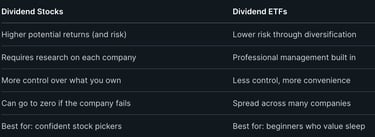
Dividend Stocks vs. Dividend ETFs: Pick Your Fighter
Individual dividend stocks give you direct ownership in one company. You buy shares of Johnson & Johnson, you own a slice of Band-Aids and baby powder.
Dividend ETFs bundle hundreds of dividend-paying companies into one ticker. Buy one share of SCHD, you instantly own pieces of over 100 dividend stocks. It's diversification in a can.
Here's the honest trade-off:
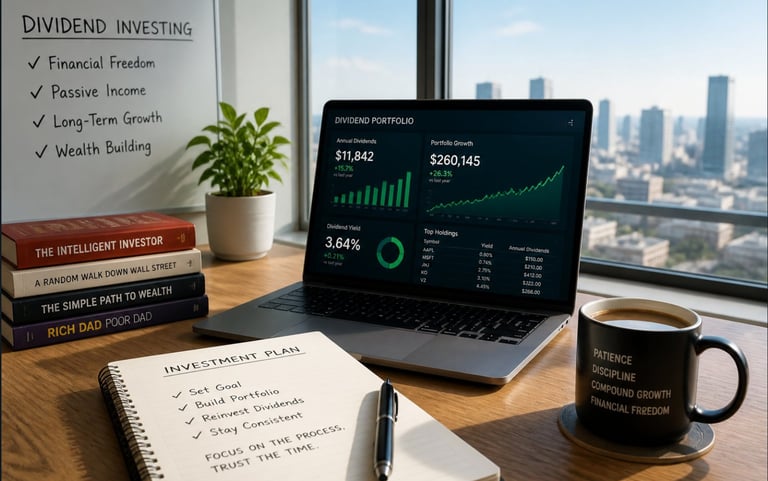

The real magic happens when you reinvest your dividends and stay consistent with your strategy. These two factors can turn modest regular investments into serious wealth over time.
Reinvesting Dividends for Compounding Magic
When you receive dividend payments, you face a choice: pocket the cash or put it back to work. Reinvesting dividends means using those payments to buy more shares of the same dividend stocks. Those new shares then generate their own dividends, which buy even more shares.
This creates a snowball effect. Your initial investment grows faster because you're earning returns on your returns.
Most brokers offer automatic dividend reinvestment plans (DRIPs). You turn them on once and forget about them. The system buys more shares for you automatically, often without charging commission fees.
Let's say you invest $10,000 in a stock paying 4% annually. Without reinvesting, you'd have $10,000 plus $4,000 in dividends after ten years. With reinvestment, you'd have closer to $14,800 total. That's $800 extra just from letting dividends do their thing.
The longer you reinvest, the bigger the gap becomes. After 30 years, the difference between taking cash and reinvesting can be tens of thousands of dollars.
Consistency: The Unsung Hero of Wealth-Building
Buying dividend stocks once won't build wealth. Adding money regularly will. Even small amounts matter when you do it month after month.
Set up automatic investments if you can. Pick an amount you can afford and have it transfer to your brokerage account every payday. $100 per month beats $1,200 once per year because you buy shares at different prices throughout the year.
This strategy is called dollar-cost averaging. You naturally buy more shares when prices drop and fewer when prices rise. You don't need to time the market or stress about buying at the perfect moment.
Consistency also builds discipline. You invest regardless of market headlines or your feelings about the economy. Most people who build wealth through dividend investing aren't geniuses. They're just patient people who kept going.
Avoiding Common Traps (And Bad Dad Jokes)
High dividend yields can be tempting, but they're often red flags. If a company pays 10% when similar companies pay 3%, something's probably wrong. The company might be struggling, and that dividend could get cut.
Don't chase dividends like your uncle chases bad puns at Thanksgiving. Focus on companies with steady dividend growth histories instead.
Another trap is putting all your money in one or two stocks. Even great dividend companies can stumble. Spread your investments across at least 10-15 different dividend stocks in different industries.
Watch out for dividend traps in declining industries too. A high yield means nothing if the company goes bankrupt. Check if the company's earnings can actually support its dividend payments before you invest.
Conclusion
You don't need to become a financial wizard overnight. Start with a dividend ETF, and you'll be earning passive income while you figure out which end of a stock chart is up.
Your three-step journey looks like this:
Buy a dividend ETF - Get instant diversification without the headache
Learn while you earn - Study dividend yields, payout ratios, and company basics as your ETF quietly pays you
Add individual stocks - Graduate to picking your own winners when you're ready
The beauty of this approach is that you're making money from day one. No need to read 47 investing books or wait until you understand every financial term. Your ETF is working while you're learning.
Start small if you need to. You can begin with $200 or even less. Many brokers offer fractional shares now, so there's no excuse to sit on the sidelines forever.
The worst mistake you can make is waiting for the "perfect moment" or until you know everything. Markets don't care about your study schedule. Your future self will thank you for starting today rather than spending another six months planning.
Pick a broker, buy your first dividend ETF, and set up automatic reinvestment. You've now officially started dividend investing. Everything else is just fine-tuning as you go.
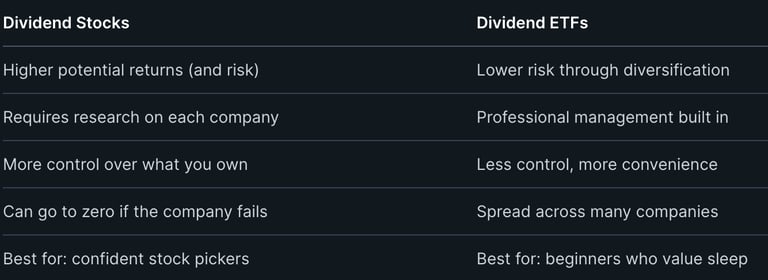
Most beginners should start with ETFs. You avoid the "I picked the one stock that imploded" experience, and you can always add individual stocks later once you understand what you're doing.
Opening Your Brokerage Account Without Tearing Your Hair Out
You need a brokerage account to buy anything. Think of it as a bank account, except it holds stocks and ETFs instead of just cash.
Pick a broker that offers commission-free trading, fractional shares, and doesn't require a minimum deposit. Fidelity, Charles Schwab, and Vanguard all work. So do newer platforms like Robinhood and Webull, though traditional brokers tend to offer better customer service when you inevitably click the wrong button.
The signup process asks for your Social Security number, date of birth, employment info, and bank details. The broker legally has to verify your identity and link a bank account for deposits.
Most accounts open within 24 hours. Some approve you in minutes.
Transfer money from your bank into the brokerage account. This can take 1–5 business days depending on the broker. Once the cash settles, you can buy investments.
Selecting the Right Dividend ETF
Start with proven dividend ETFs. Don't overthink this part.
Check out this article for the proven lists of these ETF guys!!
Initiating Your First Purchase (No Champagne Required)
Log into your brokerage account. Search for the ticker symbol (SCHD, VIG, whatever you picked). Click "Buy" or "Trade."
You'll see two options: buy a set number of shares, or buy a dollar amount. If your broker supports fractional shares, pick the dollar amount—invest exactly what you want without leftover cash sitting idle.
Enter the amount. Double-check the ticker symbol (buying the wrong thing is embarrassing and expensive). Select "Market Order" unless you enjoy waiting around for limit orders to fill.
Review and confirm. The purchase usually completes within seconds during market hours (9:30 AM–4:00 PM Eastern, Monday–Friday).
The shares appear in your account. Dividends start arriving on the fund's payment schedule, typically quarterly. Enable automatic dividend reinvestment (DRIP) in your account settings so those payments buy more shares without you lifting a finger.
That's it. You're a dividend investor now.
Supercharging Your Returns and Building Long-Term Wealth
Contact
kbgholston445@gmail.com
© 2025. All rights reserved.